Thomas Jefferson believed that an informed public is the only safe guardian of liberty. "Were it left to me to decide whether we should have a government without newspapers, or newspapers without a government, I should not hesitate a moment to prefer the latter."
Mary Spicuzza is an investigative political reporter who has covered Wisconsin elections and politics for nearly 20 years.
She is mainly focused on chasing down tips from readers to bring to light abuses of power, incompetence, scams, corruption and waste of taxpayer dollars.
Spicuzza has a background in government coverage, both at the local level and at the state Capitol in Madison where she was part of a Wisconsin State Journal team that was a Pulitzer Prize finalist for breaking news coverage.
Spicuzza has won a national awards for her work, including her investigations into her cousin's car bombing murder, Medicaid fraud, and for her PBS FRONTLINE documentary about deaths at the U.S.-Mexico border. Her work has been honored by the National Headliner Awards, Society of Professional Journalists Sigma Delta Chi Awards, Investigative Reporters and Editors, Society for Features Journalism, Associated Press Media Editors, Overseas Press Club and SABEW (Society for Advancing Business Editing and Writing). She was also a Livingston Awards finalist.
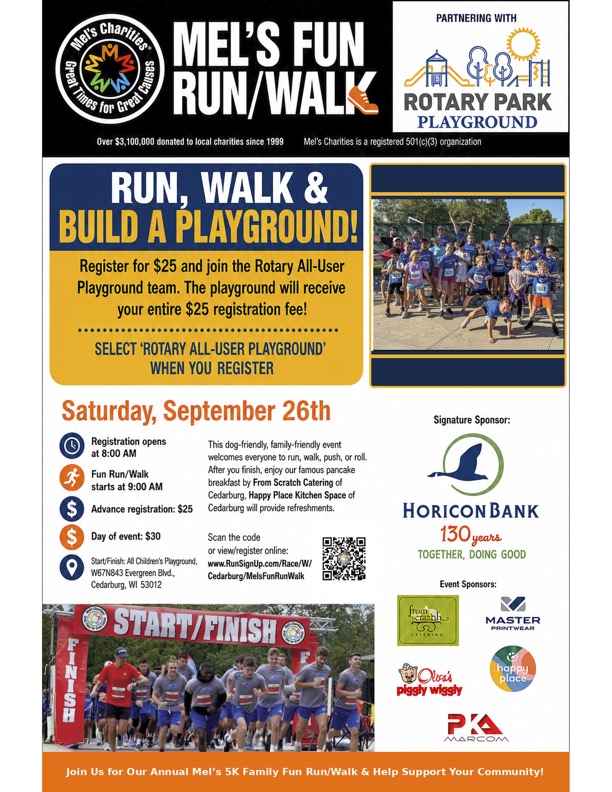
Cedarburg Community Pool on Evergreen Ave. Cedarburg, WI
Join us for this family and dog friendly event. As always, it will include a t-shirt and THE best pancake breakfast prepared by our friends at From Scratch Catering.
Date: Saturday, September 26, 2026
Registration................................ 7:00am FUN Run/Walk Start................. 8:00 am
Register for Rotary Connect & Lead 2026 Conference
Get ready to grow your skills, expand your network, and lead with confidence at Rotary Connect & Lead 2026 - a full day of professional development featuring dynamic speakers, interactive workshops, and meaningful networking.
Date: Saturday, September 26, 2026 Time: 8:15 AM – 3:30 PM Location: Concordia University, 12800 N Lake Shore Drive, Mequon
This year's lineup includes:
• Tech Tools: "Catch the Thief: Reclaim Your Day" with Don Griffing - Simple, tool-agnostic strategies to reclaim your focus and stop distractions from stealing your day.
• Leadership: "Managing Volunteers Like a Pro" with David Sakrison - Motivate volunteers without authority, delegate effectively, and avoid burnout.
• Culture: "True Ownership" with Katherine Breuss - Discover how upstream thinking transforms leadership, teams, and organizations from the inside out.
• Emotional Intelligence:"No Is Just an Opportunity" with Alexandria Binanti - Navigate organizational politics and turn pushback into progress.
• Personal Branding with Ben Bauer - Build a brand that reflects your strengths and opens doors.
• Networking: "Networking & Social Capital" with Ben Zang - A proven framework for building relationships that create real opportunities.
• Community Engagement: "From Project to Movement" with Christi Hunter - Turn service projects into partnerships that attract volunteers, sponsors, and lasting impact.
• Effective Communication with Brian Hendricks - Practical tools to communicate with clarity and confidence.
Why attend? This is a fantastic opportunity for professional growth, fresh ideas, and connecting with fellow leaders, whether you're a longtime Rotarian or new to the organization. And good news: the event is open to non-Rotary members too, so feel free to bring a friend or colleague!
Cost: $15 for Rotary Members | $25 for Friends of Rotary (lunch included)
Registration closes September 18 - don't miss out!
Save the Date: What Makes September 17–21 Different This Year?
Mark your calendar now: registration for the 2027 Rotary International Convention in Barcelona opens September 17, 2026. And this year, the first five days matter more than ever.
A Different Kind of Registration Window
If you've registered for a Rotary convention before, you may be used to a familiar rhythm of pricing tiers stretched out over many months. This year looks different. Rather than the traditional structure, registration opens with a short, five-day discount window – September 17 through 21 – before prices step up. It's a smaller window with a bigger reason to pay attention. The convention itself takes place June 26–30, 2027, at the Fira de Barcelona. This gives you plenty of time to plan once you've locked in the early rate.
The Price Difference Is Worth Planning For
Here's what registering early actually saves you:
For members, nonmembers, and guests age 31 and over:
September 17–21: $595
September 22 – March 31, 2027: $795
April 1 – June 30, 2027: $895
That's up to $300 in savings simply by registering during the opening week.
For those age 30 and under:
September 17–21: $250
September 22 – March 31, 2027: $350
April 1 – June 30, 2027: $400
Up to $150 in savings for our younger members and guests.
The takeaway is simple: the earlier you register, the more you keep in your pocket for the trip itself.
Bring the People Who Make It Meaningful
Registration isn't just for members – family and friends of any age are invited to attend. Guests ages 5–18 register at a reduced rate, and children under 5 attend free. If Barcelona has been on your travel list, or if you've always wanted to show the people you love what a Rotary convention feels like, this is the year to make it a trip together.
What Your Registration Includes
A full in-person registration gets you:
Admission to the opening and closing ceremonies and general sessions
Breakout sessions to build your communication, leadership, and project management skills
Access to the House of Friendship, where you can connect with projects and fellowships from around the world
Entertainment from local artists and musicians
Transportation between your hotel and the convention venue (if booked through Rotary's official housing partner)
Have questions or want to plan your Barcelona trip with fellow club members? Talk to your club leadership or district team – and watch for more details as the date approaches.
To access the website directly, you can click on the Hotlink in the lower right hand corner of our bulletin.
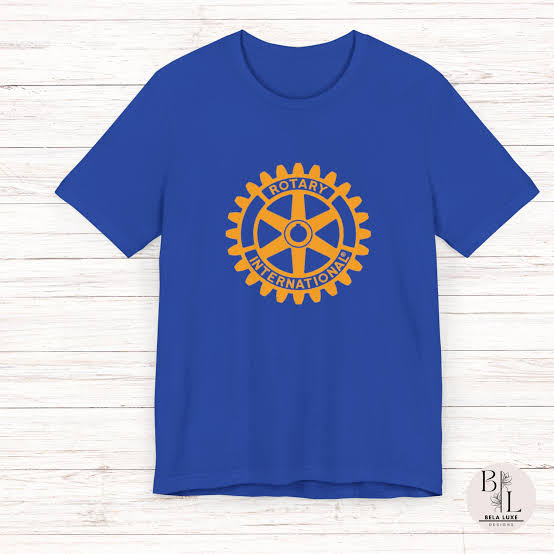
In need of more gear to show that you are a true Thiensville--Mequon Rotarian? Look no further than our newly updated Swag Store! Click on the link below to get your quality hats, shirts and pullovers, for both men and women, in a variety of sizes and colors!
The Store is OPEN!! The link below will get you to the page to order your shirts. There are pictures of each of the three Wisconsin districts’ shirts. You want to check it out and order the RID 6270 ones, at the far right of the page.
I have placed an order for one shirt of each size, for club and planning committee visits, and will let you know when I get them.
We anticipate that you will have to have your orders in by the last week in September, in order to get the shirts in time for the walk. If things change, I will let you all know.
Thanks for all the advanced planning that you are doing. I am still waiting on information on several walks. Please send me the location of your starting point. Once I get the particulars there will be a summary sheet sent out, and we can do a master press release. Send me your walk info, as asked for on the previous emails.
How Edison, Tesla and Westinghouse Battled to Electrify America
The epic race to standardize the electrical system—later known as the War of the Currents—lit up 19th-Century America.
Image Source/Getty Images
Published: January 30, 2015Last Updated: September 05, 2025
In the late 19th century, three brilliant inventors, Thomas Edison, Nikola Tesla and George Westinghouse, battled over which electricity system—direct current (DC) or alternating current (AC)–would become standard. During their bitter dispute, dubbed the War of the Currents, Edison championed the direct-current system, in which electrical current flows steadily in one direction, while Tesla and Westinghouse promoted the alternating-current system, in which the current’s flow constantly alternates.
Inventions Madness: Play Our Bracket Game
Put the contenders—from the lightbulb to the zipper to the credit card—head-to-head.
Ultimately, however, Edison failed in his efforts to discredit AC. Westinghouse won the contract to supply electricity to the 1893 World’s Fair in Chicago—beating out rival General Electric, which was formed in 1892 by a merger involving Edison’s company—and the expo became a dazzling showcase for Tesla’s AC system. Westinghouse also received an important contract to construct the AC generators for a hydroelectric power plant at Niagara Falls; in 1896, the plant started delivering electricity all the way to Buffalo, New York, 26 miles away. The achievement was regarded as the unofficial end to the War of the Currents, and AC became dominant in the electric power industry.
Feeling threatened by the rise of AC, which could be distributed over long distances much more economically than DC, Edison launched a propaganda campaign to discredit AC and convince the public it was dangerous. As part of this campaign, animals were publicly electrocuted with AC, and when New York State sought a more humane alternative to hanging its death-penalty prisoners, Edison, once an opponent of capital punishment, recommended alternating current-powered electrocution as the fastest, deadliest option. In 1890, convicted murderer William Kemmler became the first person to die in the electric chair. The apparatus, designed by an electricity salesman secretly on Edison’s payroll, was powered by a Westinghouse AC generator.
The most famous of the three visionary men, Edison, developed the world’s first practical light bulb in the late 1870s, then began building a system for producing and distributing electricity so businesses and homes could use his new invention. He opened his first power plant, in New York City, in 1882. Two years later, Tesla, a young engineer from Croatia, immigrated to America and went to work for Edison. Tesla helped improve Edison’s DC generators while also attempting to interest his boss in an AC motor he’d been developing; however, the Wizard of Menlo Park, a firm supporter of DC, claimed AC had no future. Tesla quit his job in 1885 and a few years later received a number of patents for his AC technology. In 1888, he sold his patents to industrialist George Westinghouse, whose Westinghouse Electric Company had quickly become an Edison competitor.