
Why Is a Piece of Paper 8.5 by 11 Inches?
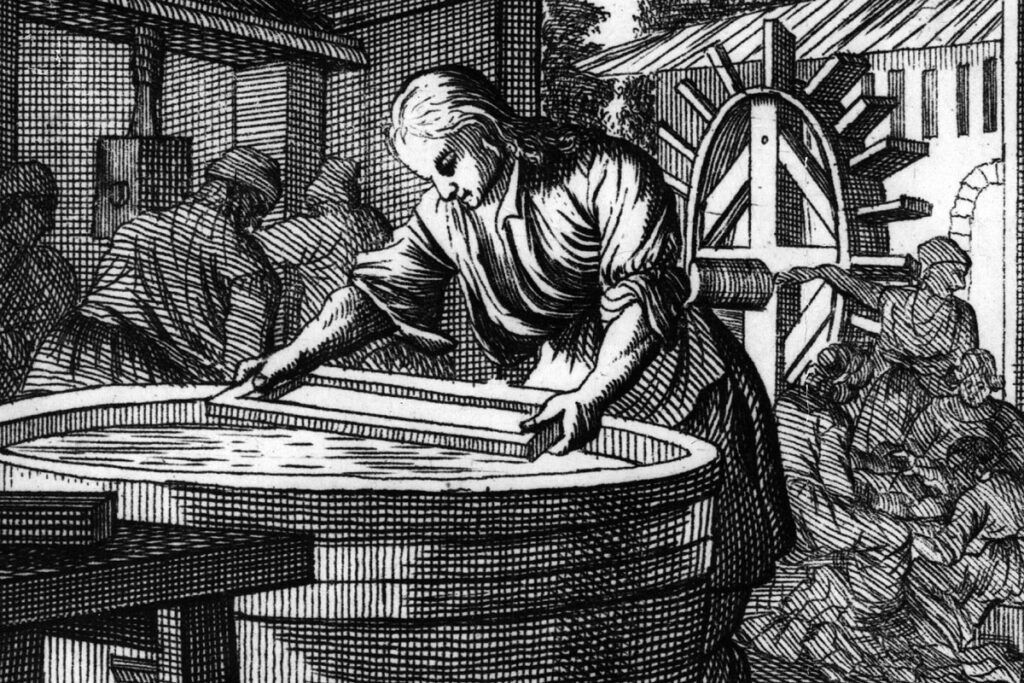
The answer goes back to the 1600s, when Dutch papermakers used wooden molds to form sheets of paper from big vats of watery pulp. The molds had to be big enough for the vatman — the worker handling the frame — to lift and shake comfortably. Through trial and error, papermakers settled on molds roughly 44 inches long, the average span of a worker’s outstretched arms. When that large sheet was quartered, the resulting pieces measured about 11 inches on their long side.
The origin of the width is less certain, but historians point to the molds’ original 17-inch dimension. Halved, that produced the familiar 8.5-inch width. In other words, the size of the modern office memo may be the legacy of how far a 17th-century worker could stretch their arms.

That still doesn’t explain why this size became the American standard. For that answer, we need to skip ahead to the 20th century, when typewriters, copiers, and printers made uniformity a necessity. A sheet measuring 8.5 by 11 inches accommodated a comfortable line length — 65 to 78 characters after accounting for margins. It also minimized trimming waste when paper was cut down from larger “parent” sheets, which were often 17 x 22 inches.
For a time, the U.S. government complicated matters. In 1921, the federal government adopted 8 by 10.5 inches as the standard size for official letterhead. Around the same time, a separate industry group — part of Herbert Hoover’s effort to reduce waste — settled on 17 by 22 inches as the size of the “parent” sheet. Halved, that produced the commercial 8.5 by 11 size that everyone outside the government was already using.
The mismatch persisted for decades, with bureaucracy running on one standard and businesses on another. It finally ended in the early 1980s, when President Ronald Reagan mandated 8.5 by 11 inches for all federal forms, aligning Washington, D.C., with the rest of the country.
As for legal-size paper — standard paper’s elongated 8.5-by-14-inch sibling — that likely owes its extra 3 inches to lawyers who wanted more room for dense contracts. Today, it’s just as likely to appear in restaurants, where that bonus space comes in handy for sprawling menus.
So the real reason your printer uses 8.5-by-11-inch paper? A mix of ergonomics, industrial efficiency, and administrative tidiness — all rooted, improbably enough, in the reach of a 17th-century papermaker’s arms.